In 2023, a CSIS wargame study concluded that in a peer-adversary conflict like the defense of Taiwan against the People’s Republic of China, the United States would exhaust its supply of critical munitions in under a week. These munitions include ship-launched interceptors like the ESSM, SM-2, and SM-6 which shoot down offensive missiles at sea, Patriot and THAAD batteries that protect against offensive missiles on land, Tomahawk cruise missiles used in long-range precision strikes, and Sidewinder missiles used in aerial interdiction. Together, these missiles form the backbone of conventional deterrence, and without them our bases, carrier groups, and aircraft are left defenseless.
When it was published in 2023, the CSIS study produced a rather sobering conclusion on its own, but this pales in comparison to the actual state of affairs today. During the first seven weeks of the 2026 conflict in Iran, open source reporting estimates that our military expended at least 50% of our critical munitions stockpile. So if in 2023 domestic stockpiles were so low that an extended conflict with China would have depleted the entire arsenal in a week, one can only deduce that today, our reserves would last only a few days.
This deficit is particularly noticeable at sea, as the US fundamentally projects power and reinforces a democratic world order through its naval carrier groups. The ships that make up these carrier groups defend themselves largely through missiles launched from their vertical launch systems (VLS). In the Red Sea conflict that first arose three years ago, the Navy used more VLS launched missiles in under a year than we can currently produce annually.
There is currently only a single primary contractor of shipborne interceptors in the United States, that being RTX Corporation. Over the past three to five decades, RTX has annually delivered approximately 300 shipborne interceptors per year. At this production rate, simply restocking what has been expended in the opening months of the Iran conflict will take years. That’s before accounting for the 50–70 new battleships and medium unmanned vessels the Navy wants operational in coming decades, each of which holding up to 128 VLS cells. Congress has already requested $70 billion for missiles next year, but even optimistic estimates suggest it will take the better part of a decade to rebuild what’s been depleted.
Meanwhile, China is manufacturing anti-ship cruise missiles that hold our carrier groups at risk at a pace that dwarfs our production by orders of magnitude. The production disparity isn’t close, with some estimates suggesting Chinese production capacity is in the multiple thousands of missiles per week.
President Franklin D. Roosevelt understood that manufacturing capacity and conventional deterrence are not separate concerns, but rather two sides of the same coin. The country that can make things faster, in greater quantities, and at lower cost dictates the course of history. This was true in 1944, when American factories produced 100,000 military aircraft in a single year, just as it’s true now, where total production of American aircraft has dwindled to just over 5,000. The decline of American manufacturing is a well-documented story. What is perhaps less appreciated is how acutely that decline has impacted our defense industrial base, and how precarious it has made our position.
But at the end of the day, we’re not geopolitical analysts, but rather engineers who love to build things. And as engineers who’ve spent our careers in aerospace and rocketry, we couldn’t look at these numbers and sit on our hands. So we didn’t.
Aris and I have been friends since high school. As a hobby, he had been building solid rocket motors since he was eight years old. He founded the Saint Louis University Rocket Lab, spent five years at Virgin Orbit managing engine tests, and later worked on aircraft propulsion systems at Supernal. I was part of USC’s Rocket Propulsion Lab, the first undergraduate team to send a rocket to space, and then spent seven years at Virgin Galactic as a test and design engineer before joining Castelion’s early team to build hypersonic platform prototypes.
We wanted to see what it would take for the two of us to start a company that could significantly move the needle in America’s critical munitions shortage, starting with producing ship-side interceptor missiles. But we weren’t going to raise money on concept in a PowerPoint deck. We wanted to actually build something, and start with a hardware MVP in hand. So before we ever made a single deck, we set out to prove our core thesis by building an actual rocket motor.
The first question was whether we could obtain a solid rocket motor cheaply and quickly with chemistry that would outperform traditional blends in processing speed without significant performance loss. This is harder than it sounds, as you can’t just buy rocket motors at tactical size off the shelf. Anything beyond the smallest hobby-grade quantities simply isn’t available in America. The big primes won’t sell it to you, and frankly, they don’t have enough for themselves. And the shortage of solid rocket motors in this country isn’t just about the finished products. This shortage presents itself at every level of the chain, from the engineers who have the formulas and experience to safely make them, the precursor sources, the tooling, the facilities, all of it is critically deficient. If you want to change the problem, you have to be willing to build the whole thing yourself.
We put together a bill of materials and split the cost down the middle, sourcing precursors from wherever we could find them, including larger industrial chemical suppliers, fireworks supply stores and hobbyist sites. Knowing which suppliers exist, in what quantities they sell, what can be safely combined together is itself a rare and hard-won form of expertise. Luckily, Aris happens to be one of a small number of people in the United States who has it.
We ordered the components, and set up our weekend shop in a garage. We mixed propellant precursors in commercial confectionary mixers, designed motor cases and pressure vessels with free open-source CAD software (and sometimes napkin sketches), and machined them at local machine shops. We quickly fabricated a static test stand from the nearby lumber yard, and even painted it black for good measure. Within just three weeks of work, we set out to the desert to fire the motor we had built.
We staked the test stand down on a remote dry lake bed in the Mojave, unspooled 1,000 feet of cable to the igniter, set up our cameras, took cover behind our trucks, and fired the thing.
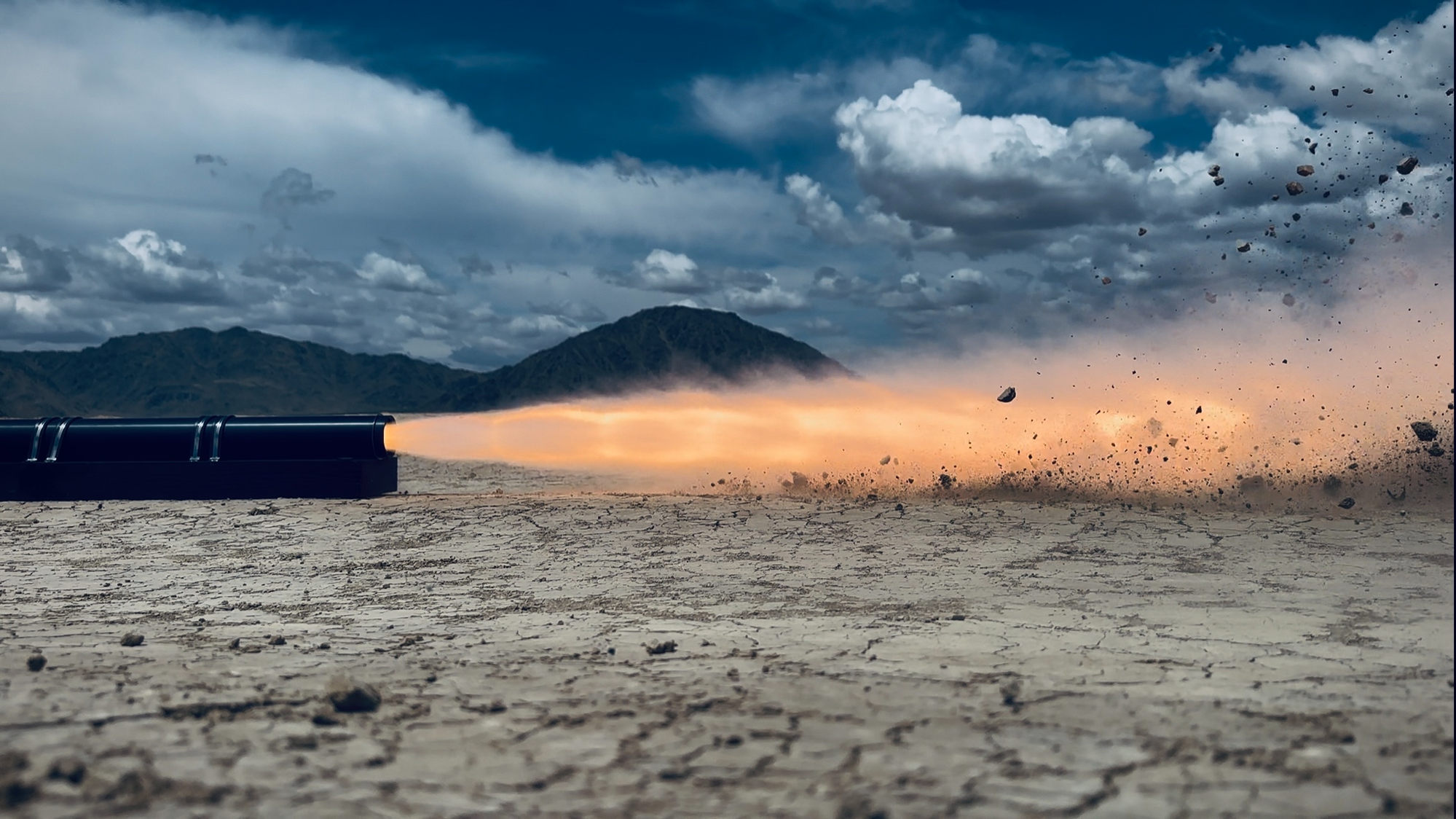
With the neon orange plume in full expansion and ripping through the blue sky behind and atop the cracked white playa, it was obvious we had something and could start this company. Within six weeks of that first successful test fire, we raised a $5 million seed round led by Silent Ventures, with participation from Bessemer Venture Partners, Humba Ventures, Multiball Capital, and others including repeat founders of companies including Anduril, Armada, and Erebor.
With capital in hand, we moved into our R&D facility, brought on our core team, and started building Furientis to invert the logic that missiles had to be exquisite to be effective, and that a few hundred units a year was the best that we could do.
We started constructing our first flight vehicles using automotive-grade extrusions as airframes. Why? Because you can source them for hundreds of dollars rather than the thousands you’d pay for precision-machined aerospace alloys, and because they’re available in the kind of quantities you’d need to actually build at scale. We used simple bolted joints to assemble major vehicle segments together. It’s neither the lightest approach, nor the most exquisite. But it’s deterministic. When we’re on a production line building thousands of these, every step works the same way every time. Just like how Vans Aircraft builds kit airplanes, IKEA builds bedframes, and Toyota builds sedans.
The same logic runs through every subsystem. For our first seeker builds, we’ve sourced high-reliability subcomponents from adjacent industries. These components perform comparably to aerospace grade parts but carry significantly lower unit cost and greater supply chain resiliency. For our first flight computers, we used industrial-grade compute rather than bespoke systems that are derivatives of 1980s era designs. We use commercial off-the-shelf electronics wherever reliability isn’t compromised, and of course, a propellant process designed to be fast and repeatable.
The entire vehicle is meant to be assembled in thirty minutes on a production line. This is an aggressive target, but forces our engineering team to keep manufacturability at top of mind and enables production rates in the thousands per year. Each Furientis factory will produce a thousand missiles per year, with each missile costing one tenth of similar range incumbent platforms.
Our first product will be a short range surface-to-air interceptor. But from there, the form factor will extend naturally to different variants to accommodate other platforms, launchers, and mission sets. The core technologies behind the first missile variants will then be used for additional families of novel rocket powered effects.
To date, we have conducted ten static firings of our rocket motor, and six flight tests of our interceptor demonstrator, and we were recently named one of five finalists in the Office of Naval Research Tactical Missile Innovation Challenge, alongside major defense companies including Anduril and Kratos. We’re moving fast, because fast is the only way to close a production gap that’s been widening for decades.
If this mission resonates with you and you want to play a major role in manufacturing defensive munitions at scale, we want to hear from you. Visit furientis.com or contact careers@furientis.com to learn more.